
Inheritance Tax (IHT) rules for pensions are changing next year. From April 2027, unused pension pots will be considered part of your estate and so could be liable for IHT.
You might have read about this in our article, ‘Why new pension rules have sparked a rise in charitable giving’, back in September 2025.
But charitable giving is just one way to lower the value of your estate for IHT purposes.
Here are five more ways to help reduce your IHT liability.
1. Make use of your allowances and reliefs
IHT is only paid on the value of your estate that exceeds certain thresholds. There are two main allowances:
- The nil-rate band is the threshold for the net value of an estate below which no IHT is paid and stands at £325,000 (2026/27).
- The residence nil-rate band adds an extra IHT-free allowance of £175,000 (2026/27), provided you pass on your home to your direct descendants.
Combined, these allowances can protect £500,000 of your estate from IHT. Additionally, any unused allowances can also pass to a spouse or civil partner on first death, giving the surviving partner a potential IHT-free estate of £1 million.
Both the nil-rate and residence nil-rate bands are currently frozen. Rachel Reeves used her Autumn Budget 2025 to announce that they will remain frozen until 2031.
Inflation, rising wages, and investment growth could all see your estate pushed into the IHT net over the next five years, so estate planning is key.
2. Reduce the value of your estate through lifetime gifting
Lifetime gifting allows you to incrementally pass on your wealth, helping to steadily reduce your estate’s value and, subsequently, any potential IHT liability.
Gifting also offers the opportunity to see how your wealth changes your loved ones’ lives – whether helping your children buy their first home or supporting them as they raise their own families – unlike wealth passed on through inheritance.
There are several annual gifting allowances you can benefit from.
Annual exemption
Every tax year, you receive a £3,000 gift allowance, known as your annual exemption. As long as the gift (or gifts) you give in a single tax year do not exceed this limit, they won’t be considered part of your estate.
Small gift allowance
You can give gifts up to £250 as many times as you want in a tax year, provided payments exceeding £250 are not given to the same person or someone who has already benefited from your full £3,000 annual exemption.
Wedding gifts
Wedding gifts are IHT-free and can help lower the value of your estate. The size of the gift you can tax-efficiently give depends on who it is given to and their relationship to you. Allowances are:
- £5,000 for children
- £2,500 for grandchildren or great-grandchildren
- £1,000 for other relatives or non-relatives.
Gifts made from your surplus income
You can also give IHT-free gifts from your own income, as long as they are consistent, regular payments and do not negatively impact your standard of living.
3. Potentially exempt transfers could become IHT-free after seven years
Gifts given outside of these allowances could create a potentially exempt transfer (PET).
PETs are only liable for IHT if the donor passes away within seven years of giving the gift. When this happens, the PET may be liable for taper relief, which charges the gift at a reduced rate of IHT.
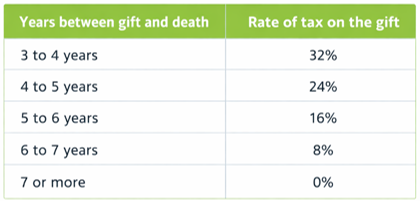
Note that if you create a PET and then pass away within three years, it could be liable for IHT at the full 40%.
Taper relief only applies to gifts in excess of the nil-rate band, so if no tax is payable on the transfer, because it does not exceed the nil-rate band (after cumulation), there can be no relief. Also, taper relief does not reduce the value transferred; it reduces the tax payable as a consequence of that transfer.
4. Equity release could substantially reduce your estate’s value
Equity release could help you free up the capital held in your most valuable asset – your home.
You can release equity by applying for a:
- Lifetime mortgage, which loans you a sum of money secured against your home
- Home reversion plan, which sells part of your home to a provider.
Once you receive a lump sum through equity release, you might choose to gift it to your loved ones to help reduce the value of your estate, and thereby reduce a potential IHT liability. However, there are potential pitfalls to be aware of.
For example, lifetime mortgages generally build up compound interest, which could leave your loved ones with significant debt to pay off after you pass away. Similarly, a home reversion plan can make it difficult if you want to move home in the future.
Importantly, you need to weigh the costs and fees associated with equity release against any potential IHT savings.
5. A financial adviser can help make your estate tax-efficient on your behalf
Pensions have previously offered an avenue for tax-efficient estate planning, allowing wealth to pass on to your loved ones after you die IHT-free in some circumstances.
However, this benefit will disappear when the new pension tax rules come into effect from April 2027.
You can use the options above to revisit your personal financial plan. Alternatively, you can reach out to your The Pension Planner financial adviser for professional guidance.
Our advisers can help you continue to build tax-efficient wealth while planning your estate and legacy, so your loved ones inherit as much of it as possible.
Get in touch
If you’d like to learn more about how The Pension Planner can help you maximise your estate’s tax efficiency, get in touch with one of our financial advisers today.
Email info@thepensionplanner.co.uk or call 0800 0787 182.
Please note
This article is for general information only and does not constitute advice. The information is aimed at individuals only.
Please do not act based on anything you might read in this article. All contents are based on our understanding of HMRC legislation, which is subject to change.
The Financial Conduct Authority does not regulate estate planning, tax planning, or will writing.
Your home may be repossessed if you do not keep up repayments on a mortgage or other loans secured on it. Equity release will reduce the value of your estate and can affect your eligibility for means-tested benefits.
A lifetime mortgage is a loan secured against your home. To understand the features and risks, ask for a personalised illustration.







 Production